
Casiny Withdrawals: Limits, Fees and Verification
 Available in AU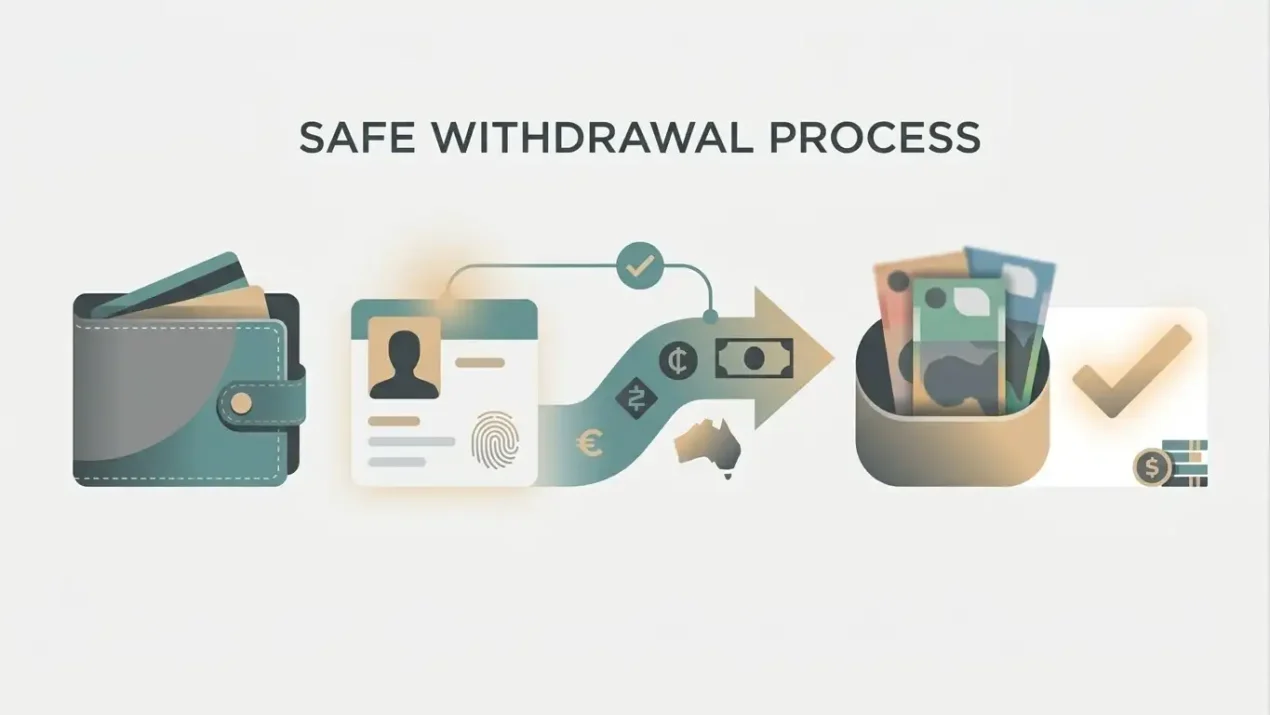
Contents
Cash-out guide for Australia
Casiny withdrawals normally go back to the original payment method and can be held until identity checks are complete. The current official terms set a minimum withdrawal of EUR 10 or the equivalent in the account currency. They also set monthly caps of EUR 5,000 equivalent when the account balance is at least ten times the total amount deposited, and EUR 10,000 equivalent in other cases. A separate 8% fee, with a minimum charge of EUR 4 equivalent, can apply when the deposit has not been wagered at least once before withdrawal. Those are current term values, not fixed AUD conversions. Casiny does not publish one guaranteed withdrawal time for every method: processing depends on the payment route, verification status and downstream provider settlement.
Before cashing out: check the live withdrawal screen and current Casiny terms. Exact AUD equivalents can move with account currency conversion, while payment-provider settlement can add time outside the operator’s own processing.
How a Casiny withdrawal works in practice
The operational flow starts inside the cashier. You choose an available withdrawal route, enter the amount and submit the request. Casiny’s terms say withdrawals should be made to the original debit card, credit card, bank account or payment method used to fund the account. The operator can allow a different destination at its discretion, but the terms say that doing so is subject to additional security checks.
That original-method rule matters because a deposit method is not just a way to move money in. It establishes a payment trail that can later be used when money moves out. If a player deposits by one route and then expects to cash out through a completely unrelated route, the request can require extra review rather than being treated as a simple switch.
The second layer is account verification. Casiny reserves the right to request photo identification, proof of address, a selfie, a verification call or other checks before granting a withdrawal. The broader registration terms also permit requests for picture ID and a recent utility bill or other proof of residence. A pending KYC request can therefore become the main reason a cash-out is not yet released, even when the payment method itself supports withdrawals.
Current withdrawal limits and the AUD-equivalent issue
The current terms use euro-denominated thresholds with an equivalent amount in another account currency. The minimum withdrawal per transaction is EUR 10 equivalent, except when an account is being closed and the full remaining balance is withdrawn. For monthly withdrawals, the terms distinguish between two balance situations.
| Rule in current terms | Published threshold | What an Australian player should check |
|---|---|---|
| Minimum withdrawal | EUR 10 or account-currency equivalent | Live AUD equivalent shown for the account |
| Monthly cap when balance is at least 10x total deposits | EUR 5,000 equivalent | How the account qualifies for this lower cap and the current AUD equivalent |
| Monthly cap in other cases | EUR 10,000 equivalent | Current account-currency equivalent and already processed withdrawals in the month |
It would be misleading to hard-code an AUD figure here because the source terms define the thresholds in euro or currency equivalent. An exchange-rate conversion made for a review could become stale, while the operator’s account system is the relevant place to see the amount applied to a specific AUD account. The decision-useful point is the structure of the rule: the published monthly ceiling can be lower when the balance is very large compared with cumulative deposits.
This limit is separate from any limits or operational restrictions imposed by the card issuer, bank, wallet, crypto service or other payment provider. The casino can approve an amount that still takes additional time to settle through the payment rail.
When the 8% withdrawal fee can apply
Casiny’s current terms state that there are no withdrawal commissions when the deposit has been wagered at least once. If that one-time wagering condition has not been met, the operator is entitled to deduct an 8% fee with a minimum charge of EUR 4 or the equivalent in the account currency. This is a specific anti-money-laundering condition in the published terms, not a general statement that every withdrawal carries an 8% fee.
The practical implication is straightforward. A player who deposits and then immediately requests most of the same funds back without any wagering can trigger a fee that would not apply after the stated one-time wagering condition has been satisfied. That does not mean wagering should be increased merely to avoid a charge. It means the rule should be known before a deposit is made, especially if there is a chance the funds will need to be returned unused.
Fee check before submitting a request
- Confirm whether the relevant deposit has met the one-time wagering condition.
- Read the current fee wording rather than relying on an old screenshot or review.
- Check the account-currency equivalent if the minimum fee is displayed in AUD.
- Separate any Casiny fee from charges imposed by a bank, card provider, exchange or network.
Verification can be the critical path to payout
Casiny can request identity and address evidence before a withdrawal and can conduct verification at any time during the customer relationship. The terms give examples that include a passport, driver’s licence or national ID card, a recent utility bill showing name and address, a selfie and a verification call. These are examples of checks the operator may request, not a promise that every account will be asked for every item.
The best preparation is consistency. The personal details on the account should match the identity documents and, where relevant, the owner of the payment method. A blurry file, expired document, mismatched address or payment method held in another person’s name can create avoidable follow-up questions. If the account receives a verification request, respond to the request actually shown rather than uploading extra documents that were not asked for.
For a fuller explanation of verification, including why checks can arise at registration or later, see the dedicated Casiny KYC guide. This withdrawal page focuses on how verification interacts with cash-out rather than duplicating the entire account-verification process.
Operator processing and payment-provider settlement are different stages
A useful way to read any withdrawal-time claim is to split the journey into stages. First, the request must be accepted by Casiny. That stage can include account review, KYC, bonus or transaction checks and confirmation that the destination method is permitted. Second, once the operator releases the payment, the bank, card network, wallet, crypto network or other provider has to settle it.
Casiny’s current public wording says withdrawal times depend on the payment method and account status and that withdrawals are intended to be processed after verification. It does not provide one universal guaranteed number of hours for every route. Because of that, a review should not turn a fast example from one method into a site-wide promise. A card cash-out, bank route and crypto transaction can have different downstream behaviour even after operator approval.
This distinction also helps when diagnosing a delay. If the request still shows as pending with the operator, the relevant question is usually account review or processing. If Casiny shows the withdrawal as completed but the funds are not yet visible, the payment provider may be the relevant next checkpoint.
Why the original payment method matters
The terms require withdrawals to return to the original payment source as the default. This supports a consistent transaction trail and limits the use of the casino account as a way to move funds between unrelated financial instruments. Casiny can permit another destination, but the terms make that discretionary and subject to extra security checks.
For Australian users comparing deposit methods, this means cash-out compatibility should be considered before funding the account. A convenient deposit route is less useful if it creates an awkward withdrawal path later. The separate Casiny deposit methods page explains the funding side, while the parent Casiny payments Australia guide puts deposits and withdrawals in one broader AUD context.
Where a payment route cannot receive withdrawals, the live cashier and support process are more reliable than assuming a particular fallback. The terms give Casiny discretion to approve an alternative route, but they do not justify inventing a universal alternative method for every Australian account.
A practical pre-withdrawal checklist
Most avoidable withdrawal friction comes from details that can be checked before the request is submitted. The objective is not to predict an exact payout time. It is to remove the common reasons a request needs clarification, re-routing or additional verification.
- Confirm that the requested amount is above the current minimum and within the applicable monthly cap.
- Check the live AUD-equivalent values rather than relying on a static currency conversion.
- Use the original payment method where the cashier allows it.
- Make sure account identity details are accurate and current.
- Complete any requested KYC before expecting the payment to be released.
- Check whether the deposit has met the one-time wagering condition relevant to the published withdrawal fee.
- Keep a record of the request amount, date and payment route.
- If a request is marked completed but funds have not arrived, distinguish operator completion from provider settlement.
If the issue concerns account access rather than the payment itself, the Casiny registration Australia guide covers account and login mechanics. For the regulatory position of the service in Australia, use the separate Casiny licence Australia page rather than treating payment availability as evidence of local authorisation.
What not to infer from a successful payout
A completed withdrawal is evidence that a particular transaction was processed; it is not evidence that the operator holds an Australian online-casino licence or that Australian regulatory protections apply. Payment functionality and regulatory status are separate questions. That distinction is particularly important in Australia, where access to an AUD-facing service does not by itself establish local authorisation.
For the same reason, a smooth first withdrawal should not be turned into a universal promise about later requests. Different amounts, verification states and payment methods can produce different processing paths. The useful evidence is the current terms, the live cashier and the status of the specific request.
For broader context, see Casiny casino Australia.
The Casiny withdrawal checks that matter before an AUD cash-out
For Australian users, the most important Casiny withdrawal checks are the destination method, verification status, live currency equivalent and the one-time wagering rule linked to the published fee. The current terms provide concrete euro-equivalent minimums and monthly caps, but a static AUD conversion would be less reliable than the amount shown on the account. Keep operator processing separate from bank, wallet or network settlement when judging speed. If those checkpoints are clear before the request is submitted, the cash-out process is easier to interpret without relying on unsupported promises about instant payment.
This material was created by the Casiny Australia Guide team.
Related posts

Casiny Deposits in Australia: AUD, Cards and Crypto

Casiny Pokies for Australian Players